


What are Data Collection Errors and How Do They Affect Research?
In any type of research, data quality is fundamental to ensure that results are valid and representative. Errors in data collection can directly affect the reliability of findings and lead to misguided conclusions. These errors can result from various factors, from a defective survey design to a poor interpretation by participants.
Data collection errors can arise at different stages of the process, from planning to collection and analysis. Identifying and minimizing these errors is essential to ensure that the research is solid and the results are defensible.
Types of Common Errors in Quantitative and Qualitative Data Collection
Errors in Quantitative Data
-
Sampling bias: Occurs when selected participants are not representative of the target population. This can lead to biased and non-generalizable conclusions.
-
Measurement errors: These errors arise when measurement tools or instruments (such as surveys or tests) do not function correctly or are interpreted incorrectly by participants.
-
Lack of standardization: Inconsistency in how surveys or interviews are administered can lead to inconsistent data, affecting the comparability of responses.

Errors in Qualitative Data
-
Researcher bias: In qualitative research, the researcher's prejudices or expectations can influence the interpretation of responses, compromising data objectivity.
-
Incorrect interpretation of responses: Qualitative responses are more subjective and can be misinterpreted if the full context is not considered.
-
Lack of sample diversity: In qualitative studies, it is crucial that samples represent diverse perspectives, as a homogeneous sample can limit the depth of findings.
How to Prevent Errors in Online Surveys and Interviews
Online surveys and interviews are common tools for data collection, but they require certain precautions to avoid errors:
-
Clear and precise survey design: Ensure that questions are clear and formulated to avoid ambiguous answers. Use standardized response scales to ensure consistency.
-
Survey piloting: Conduct pilot tests before launching the survey or interview to a broader sample. This allows identifying possible confusions or technical problems that might arise.
-
Controlled data collection: Establish rigorous controls to prevent duplications or fraudulent responses. The use of specialized platforms or online panels like Netquest helps obtain valid and representative data.
-
Appropriate incentives: Offering incentives, such as access to results or certificates, can increase the response rate and ensure that enough quality data is collected.

The Importance of Data Quality in Market Research
Data quality in market research is essential for informed and strategic decision-making. Erroneous data can lead to misguided decisions, affecting the effectiveness of marketing campaigns, product design, or even the company's strategic approach.
Data collection errors can influence the validity of market segmentation, trend identification, and consumer behavior evaluation. In this sense, careful and controlled data collection is fundamental for creating accurate consumer profiles and obtaining insights that truly add value to the business.
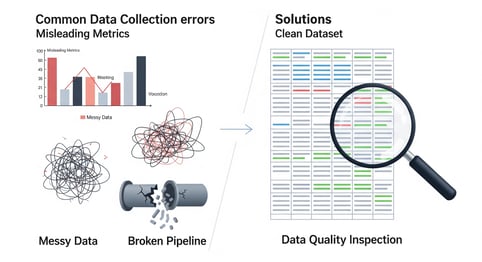
Best Practices for Reliable Data Collection
-
Establish a clear methodological framework: Precisely define the type of data you need and how it will be collected. Ensure all participants understand the research objective.
-
Train data collectors: If you are using surveyors or interviewers, it is vital that they receive adequate training on how to handle interviews, ask clear questions, and record responses consistently.
-
Sample validation: Ensure that the sample is balanced and representative of the target population. Use techniques like stratification to ensure all relevant segments are covered.
-
Continuous monitoring and analysis: Continuously monitor data collection to identify any potential errors in real-time. This includes checking the consistency of responses and performing preliminary analyses of the collected data.
-
Review data before final analysis: Before starting to analyze the data, review its quality. Filter inconsistent or incorrect responses and ensure that the data is complete and well-organized.