

Imagine you want to know the favorite food of all students in a country. You have two options: choose students from each class in a balanced way or select entire schools at random and ask only there.
Although both methods work for research, the results can change a lot depending on the type of sample you use.
Here appears a very common doubt in research: the difference between stratified random sampling and cluster sampling. And although their names seem complicated, understanding them is easier than it seems.
In this article, you will discover how each method works, when it is convenient to use one or the other, and what their advantages and disadvantages are in market research, surveys, and social research.
What is sampling in research?
Before understanding the difference between cluster and stratified sampling, we must first understand what sampling is.
Sampling is the process of selecting a part of a population to study it.
For example:
- A company wants to know the opinion of Spanish consumers.
- Instead of asking millions of people, it selects a smaller sample.
The key is that this sample accurately represents the entire population.
What is stratified random sampling?
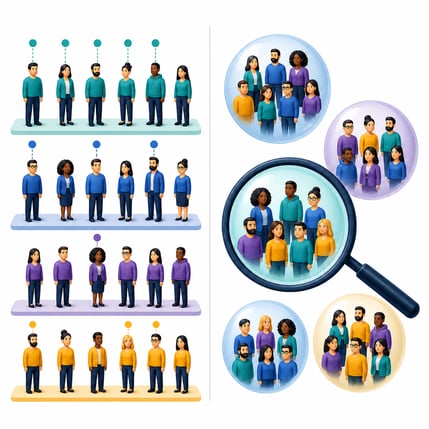
Stratified sampling consists of dividing the population into groups called strata and selecting people from each group.
Strata are usually created based on important characteristics such as:
- Age
- Gender
- Socioeconomic level
- Geographic location
Then, participants from each group are chosen randomly.
Simple example of stratified sampling
Imagine a survey about digital habits.
The population is divided into:
- Young people
- Adults
- Elderly people
Then, people from each group are selected. This ensures that all profiles are represented.
Advantages of stratified sampling
- Greater precision: Reduces the risk of leaving out important groups.
- More representative results: The sample better reflects the reality of the population.
- Lower sampling error: By controlling the sample's composition, results are usually more reliable.
Disadvantages of stratified sampling
- Requires more prior information: It is necessary to know the population well before dividing it.
- Can be slower: Organizing the strata takes more time.
- Greater complexity: The statistical design is usually more advanced.
What is cluster sampling?
Cluster sampling works differently.
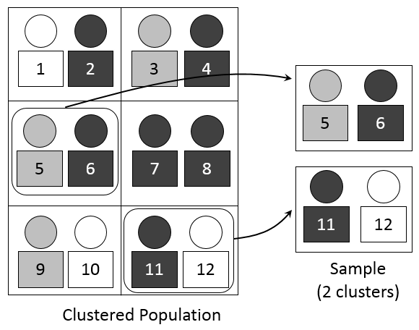
Instead of selecting individuals from the entire population, entire groups called clusters are chosen.
These clusters can be:
- Schools
- Cities
- Neighborhoods
- Companies
- Hospitals
Then, all individuals in the selected group or a part of them are studied.
Simple example of cluster sampling
A company wants to analyze purchasing habits in Spain.
Instead of interviewing people from all over the country, it selects:
- 10 cities at random
And conducts the surveys only in those cities.
Difference between stratified random sampling and cluster sampling
Here is the most important point of the article.
Although both methods divide the population into groups, the logic is completely different.
In stratified sampling:
- Groups are internally homogeneous.
- People are chosen from all groups.
In cluster sampling:
- Groups are heterogeneous.
- Only some complete groups are selected.
Quick comparison table
| Characteristic | Stratified Sampling | Cluster Sampling |
| Objective | Represent all groups | Facilitate data collection |
| Selection | Individuals from each stratum | Entire groups |
| Precision | High | Medium |
| Cost | Higher | More economical |
| Complexity | High | Medium |
| Common use | Precise studies | Large and dispersed studies |
Difference between stratified and cluster sampling: an easy explanation
A simple way to understand it is this:
- Stratified sampling: “I want a little bit of every type of person.”
- Cluster sampling: “I am going to choose some complete groups and study only those.”
When to use stratified sampling?
This method is ideal when:
- The population is very diverse.
- You need precision.
- You want to compare specific groups.
For example: Electoral studies, consumer research, age or gender analysis.
When to use cluster sampling?
It is useful when:
- The population is widely dispersed.
- The budget is limited.
- The study covers large areas.
For example: National surveys, educational studies, healthcare research.
Difference between cluster and stratified sampling in market research
In market research, both methods are widely used.
Stratified sampling helps obtain more precise data on consumer profiles. Meanwhile, cluster sampling helps reduce costs when the research covers large territories.
Specialized companies like Netquest work with advanced methodologies to ensure representative samples and reliable data in online studies.
Common mistakes when choosing a sampling type
Many researches fail because they use the wrong method.
- Error 1: Choosing unrepresentative clusters. If the selected groups are too similar, the results will be biased.
- Error 2: Creating poorly defined strata. If the groups lack statistical sense, the sample loses quality.
- Error 3: Confusing both methods. Although they seem similar, they have different objectives. And using the wrong method can increase the sampling error.

Which is better: stratified or cluster?
There is no "better" method for all cases.
It depends on:
- The study's objective
- The budget
- The available time
- The required precision
If you seek precision: Stratified sampling is usually better.
If you seek speed and savings: Cluster sampling can be more practical.
How to choose the right method
Before selecting a sampling type, it is advisable to answer these questions:
- Is the population homogeneous or diverse?
- Do I have enough budget?
- Do I need highly precise results?
- Is the population geographically dispersed?The answer will help decide which methodology to use.
FAQs about the difference between stratified and cluster sampling
What is the main difference between stratified and cluster sampling?
Stratified sampling selects people from all groups, while cluster sampling selects entire groups.
Which method reduces the sampling error more?
Normally, stratified sampling offers greater precision and lower statistical error.
Which method is more economical?
Cluster sampling is usually cheaper and faster, especially in large studies.
Conclusion
Understanding the difference between stratified random sampling and cluster sampling is fundamental to designing reliable research.
Although both methods work with groups, their objective and functioning are very different.
Stratified sampling seeks precision and balanced representation. In contrast, cluster sampling prioritizes practicality and cost reduction.
Choosing the right sample type helps obtain better data, reduce errors, and make smarter decisions in any research.