


Online market research is an essential tool for companies wishing to better understand their consumers' needs, identify growth opportunities, and adjust their business strategies. Unlike traditional methods, online research allows for faster, more accurate, and more accessible data. Furthermore, it enables real-time analysis of how consumers interact with your brand or products, which facilitates informed decision-making.
If you want to delve deeper into market research, I leave you with this complete guide to conducting effective market research.
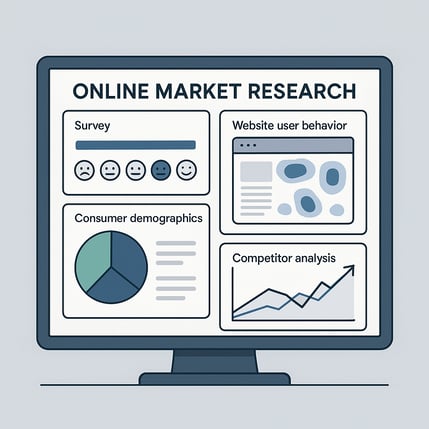
Key Aspects of Online Market Research
1. Tools and Platforms for Online Research
There are various tools that allow for efficient online market research. Among the most used are platforms like Google Surveys, SurveyMonkey, and behavior analysis tools like Google Analytics and Hotjar. These tools allow you to conduct surveys, collect data, and analyze how users interact with websites.
Risk: Not using the right tools can lead to inaccurate results, limiting the study's validity.
Recommendation: Make sure to choose platforms that offer access to representative data and easy-to-interpret analysis tools.
2. Data Collection Through Surveys
Online surveys are one of the most direct and effective ways to obtain information about consumer preferences, needs, and behaviors. These surveys can be distributed through emails, social media, or even directly on your website.
Risk: Poorly designed surveys or those with ambiguous questions can generate unreliable data.
Recommendation: Design clear questions and use a representative sample of your target audience to obtain valid results.
3. Analysis of Digital Behavior Data
Online consumer behavior provides a wealth of valuable information. Tools like Google Analytics and Netrica allow you to analyze how users navigate your website, which products they visit, how much time they spend on each page, and what drives them to make a purchase.
Risk: Misinterpreting behavioral data can lead to erroneous conclusions about consumer needs.
Recommendation: Use this data to detect behavioral patterns and improve the user experience on your website.
4. Consumer Segmentation
An essential part of online market research is segmentation. With tools like Facebook Insights or Google Analytics, you can identify different segments of your audience based on their demographics, purchasing behavior, and product preferences. This allows for the creation of more personalized and targeted marketing campaigns for each specific group.
Risk: Not segmenting your audience correctly can make your marketing efforts ineffective.
Recommendation: Use segmentation to personalize your communication and improve the conversion rate of your campaigns.
5. Competitor Monitoring and Analysis
Competitive analysis is fundamental to understanding how your brand is positioned against competitors. Online market research tools allow you to track your competitors' performance, identify their strengths and weaknesses, and observe their marketing strategies.
Risk: Not being aware of what your competitors are doing can cause you to miss opportunities or fall behind.
Recommendation: Continuously track your competitors' strategies and adjust your offering according to their market moves.

Best Practices for Effective Online Market Research
Use Verifiable Data Sources
It is fundamental that any data obtained through online research comes from verifiable sources. This guarantees the accuracy and reliability of the information that will be used to make strategic decisions.
Complement with Qualitative Data
Although quantitative data is crucial, qualitative data, obtained through interviews or focus groups, can provide deeper context about consumers' motivations and thoughts. Combining both types of data allows for a more complete view of the market.
Update Research Regularly
The online market is dynamic and constantly changing. It is important to update market studies to reflect new trends, changes in consumer behavior, or competitor movements. Continuous research ensures that your decisions are always based on current data.
Maintain Ethics in Data Collection
It is essential to be transparent with consumers about how their data will be used and to ensure compliance with all privacy and data protection regulations, such as the General Data Protection Regulation (GDPR) in Europe.